Pension plans are reaching their strongest funded levels in decades, creating a rare opportunity for sponsors to lock in gains by more precisely aligning assets with liabilities. By incorporating strategies such as key rate duration, STRIPS, and interest rate swaps, plans may better protect funded status from future market volatility.


Quick takeaways
- With corporate DB funded status at a 25-year high, sponsors may have a favorable opportunity to lock in gains and help shield plans from future volatility. Proactive de-risking at this stage can help insulate plans from future funded status volatility and reduce the likelihood of additional sponsor contributions.
- For closed and frozen plans, the risk–return profile is inherently asymmetric. Incremental gains in funded status will translate into excess surplus that is effectively trapped and costly to access, often requiring the payment of significant excise taxes, while downside risks remain. This imbalance reinforces the rationale for prioritizing funded status preservation over return-seeking strategies.
- De-risking strategies that incorporate fixed income allocations aligned across the yield curve, by matching key rate duration points, can significantly improve the match between asset cash flows and liability obligations. This more precise alignment can enhance the effectiveness of liability hedging and helps mitigate funded status volatility.
- Incorporating STRIPS and interest-rate derivatives, such as swaps, into an LDI framework may enable more precise hedging of liability interest rate exposure. These instruments can allow sponsors to better target specific points along the term structure, helping to further reduce funded status volatility and effectively taking interest rate risk off the table.
The average funded status of the 100 largest U.S. defined benefit (DB) plans hit a 25-year high at the end of February 2026. According to Milliman’s Pension Funding Index, average funded status stood at 109.4%, a level not seen since mid-2001, before the full impact of the early-2000s technology market downturn had unfolded.
With improvements in funded status, the general focus for many plans is now on preserving gains and managing risk effectively. That often means assessing whether the current liability-driven investing (LDI) program is truly aligned with the shape of the plan’s liabilities, or whether unexpected market moves could erode funded status.
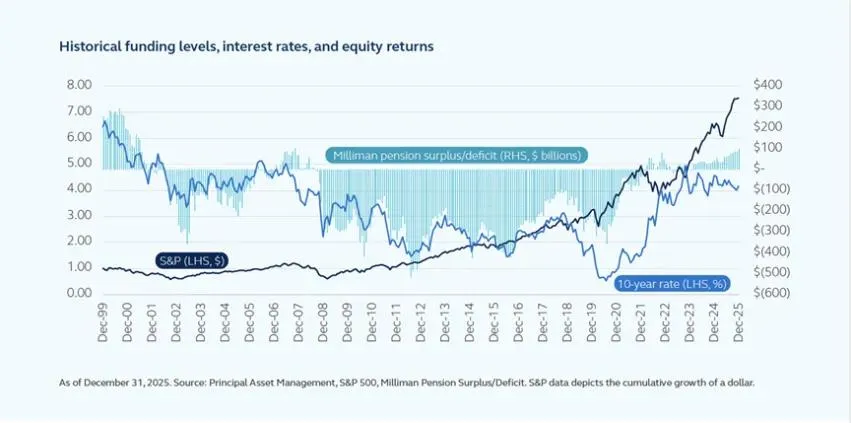
Long-duration bonds form the backbone of most LDI portfolios, but they typically don’t fully capture the complexity of liability interest rate risk. While these mandates typically consist of bonds with maturities of 10 years and longer, pension liabilities represent a series of cash flows that vary over time and often extend much further into the future, requiring a more tailored maturity structure.
As a result, even portfolios that appear well matched on an average duration basis may remain exposed to changes in the shape of the yield curve. When interest rates move non-parallel across maturities, mismatches between asset and liability sensitivities can emerge, leading to funded status volatility.
Importantly, LDI isn’t about timing interest rates or taking directional views. Rather, its objective is to mitigate the impact of rate movements on funded status, particularly for well-funded plans. Without a thoughtfully constructed LDI framework, plans remain exposed to both level and curve risk, which can materially affect outcomes.
To help improve the efficacy of LDI portfolios and to help protect funded status, it’s important to align the duration of fixed income assets with the specific cash-flow profile of the plan’s liabilities. One way to do this is to incorporate key rate duration, which measures a bond’s sensitivity to interest rate changes at specific points along the yield curve.
In practice, this involves segmenting liabilities into maturity buckets such as 5-15 years, 15-25 years, and 25+ years and constructing hedges for each segment independently. This approach allows for a more precise alignment between asset exposures and the timing of liability cash flows.
By improving this alignment, sponsors can help reduce funded status volatility arising from non-parallel shifts in interest rates. A key rate duration framework, supported by more granular maturity allocations, can therefore play an important role in addressing mismatch risk in pension portfolios.
LDI portfolios are primarily composed of high-quality corporate bonds and U.S.Treasurys. Because plan liabilities are discounted using AA-rated corporate yields, corporate bonds tend to provide a natural, but incomplete, hedge. For example, in stressed markets, credit spreads tend to widen, leading to a fall in corporate bond prices. This decline may not be fully offset by the rise in the liability discount rates, potentially leading to a deterioration in funded status.
Treasurys may mitigate this risk as they have historically performed well during periods of market stress when investors seek high-quality, liquid assets. But that shelter comes with a trade-off; typically lower yields relative to corporate bonds, resulting in reduced income to support pension obligations.
To enhance hedging precision, many plans complement core allocations with separately traded registered interest and principal securities (STRIPS) and interest-rate swaps. STRIPS function like zero-coupon bonds and provide pure interest-rate exposure, which can be particularly effective for hedging long-dated liabilities. Including STRIPS in the 25+ year key-rate-duration bucket may help align that portion of the portfolio with the longest portion of the plan’s liability profile.
Interest-rate derivatives can be another important investment tool, enabling plan sponsors to gain targeted exposure to long-duration interest rates beyond what is available through physical bonds. They can also be used to address residual gaps in the hedge after the bond portfolio is constructed, a practice commonly referred to as a “completion strategy.”
For plans that have achieved full funding, the current environment presents a compelling opportunity to preserve that position. While each plan's objectives may differ, ranging from hibernation to preparing for a pension risk transfer, a disciplined and thoughtful approach to hedging is critical.
By aligning assets and liabilities more closely and leveraging a broader set of strategies to help manage interest rate risk, sponsors can better protect the funded status levels that are among the highest in more than two decades. In doing so, they can meaningfully reduce downside risk and limit the likelihood of future contributions, particularly given the asymmetric risk profile many plans face.
Connect with your Principal® representative to explore how these considerations can fit into your plan's long-term strategy. Together, we can chart a course that helps protect funded status and positions the plan for the future.