Looking for a helpful way to guide development of a robust key employee benefits plan? The four Rs can help.

Quick takeaways
Key employees—those people who you can’t imagine doing business without—are found up and down organizations, at every level. There’s the admin who knows where all the digital files are saved, the manager who worked up through sales and understands every aspect of the business.
But what if one of those essential employees left for a new role, or to retire? It’s a concern for plenty of leaders: 60% of business owners worry about keeping top talent, according to the
A thoughtful key employee benefits plan can make a meaningful impact for employees and help your business too. How? Most key employee benefit plans start with the four “Rs” as a focus:
- Recruit top talent.
- Reward (and motivate) key employees with performance-based incentives that help achieve business goals.
- Retain key employees by helping them achieve financial goals.
- Diversify long-term income for key employees so they can retire with confidence.
What’s a benefits plan for key employees that addresses each of these areas and helps you meet business goals? Here’s how to find out.
Recruit: What benefits matter to key employees?
The demand for a certain benefit isn’t universal for all employees. A benefit—say, health insurance—may matter to a lot of people, while another matters to only a few. Or, a benefit might be widely preferred in an industry or field.
Let’s look at health insurance: It’s the most important benefit for 96% of all employees.
Knowing what’s preferred by most potential key employees gives your benefits packages a guiding baseline; you’ll know that you probably have to provide that benefit to attract the best talent. The rest of what you throw in the mix is probably influenced by who works for you, what the competitive landscape looks like, and your location. (For example, a mass transit credit won’t matter if your company locale doesn’t have a train or wide bus service.)
Keep in mind two other factors that matter to recruit key employees. First, if you’re competing in a hot labor market for big-value skills or roles, you may have to adjust your key employee benefit plan to reflect that.
Second, in this digital age of work-from-anywhere, your competition isn’t just in the next street or town over. “You’re really competing with everyone,” says Amy Friedrich, president, benefits and protection, Principal Financial Group®. “The more you understand what other employers are offering out there, the better positioned you’ll be to hire and keep top talent.”
Motivation comes in all different forms. For employees, it’s often additional compensation tied to milestones or goals: individual, company-wide, or both.
How you set up performance-based incentives is up to you, and no set rules apply. For example, in the past, more senior employees had more options for some incentive-based compensation. But opening it up sooner and to younger employees may help those individuals feel more invested in the organization. This is especially true if you have a knowledge-based business that may offer future partner opportunities: Incentive pay isn’t just about rewards, but growth and longevity, too.
Remember: Both for-profit and tax-exempt organizations can use the structure of key employee benefits packages to help achieve your goals. Some incentives may offer tax benefits for your business, while others do the same for employees. Or, you may have the option to structure them as employee deferrals, discretionary employer contributions, or both. Your financial professional can help you find the option that’s best for you.
Your key employees are as worried about goals—saving for retirement, planning for college, for example—as anyone else. There are creative additions to key employee benefits plans that can help, and motivate them to stay in order to hold on to that benefit.
For example, an
Key employee life insurance policies come in many forms, including split-dollar life insurance. In that case, your business and the key employee split the cost of the policy, with opportunities for loans for the employee. Check with your financial professional to help determine which type of coverage might make sense for your business’s goals and key employee needs.
There’s very often a difference between what key employees are able to save for retirement, and what they think they might need. That’s what’s known as the income replacement gap. If those key employees are meeting their yearly contribution limits for retirement savings, they may struggle with how to put aside additional amounts.
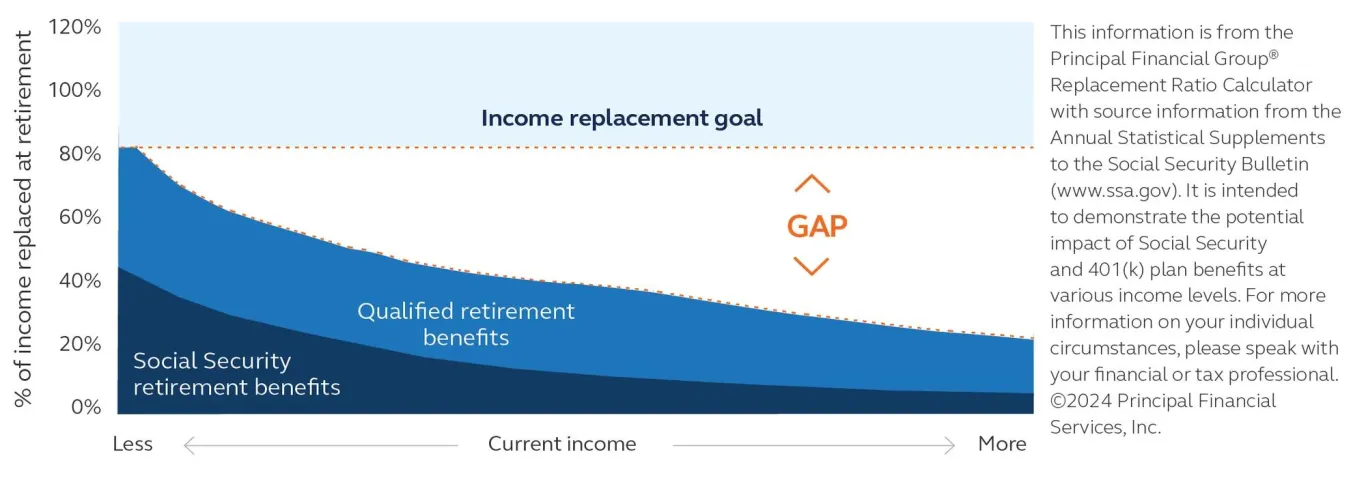
Retirement-focused elements of key employee benefits plans can help. Here’s how.
Say you have a key employee who has contributed the maximum to both 401(k) plans and individual retirement accounts (IRAs). By adding a
What’s next?
Learn more about