
Quick takeaways
When you chose your investments, you probably selected a mix that fit your goals, timeline, and comfort with risk. But that mix might not stay the same over time.
Think about driving on the highway. You've chosen your speed and direction and hit cruise control, but you still need to pay attention to the road. Over time, your car can gradually drift, requiring a small correction to stay on course.
Investments can drift, too. Some investments may grow faster or lose more value than others. That can change how much of your money is invested in stocks, bonds, and other investments, even if you haven't changed a thing. As a result, you could be taking on more risk or being more conservative than you intended.
This is where rebalancing comes in. Rebalancing means adjusting your investments to bring your mix back in line with your intended strategy. Think of it as a routine checkup to help make sure your investments still reflect your goals and the right amount of risk for you.
Suppose you originally decided to put 60% of your retirement savings in stocks and the remaining 40% in bonds. That 60/40 split is your target investment mix, sometimes called your
Now imagine that stocks perform particularly well. Over time, they might make up 70% of your account while bonds make up only 30%.
Rebalancing is the act of bringing those percentages back in line with your original investment mix. In this example, you’d rebalance your portfolio to 60% stocks and 40% bonds.
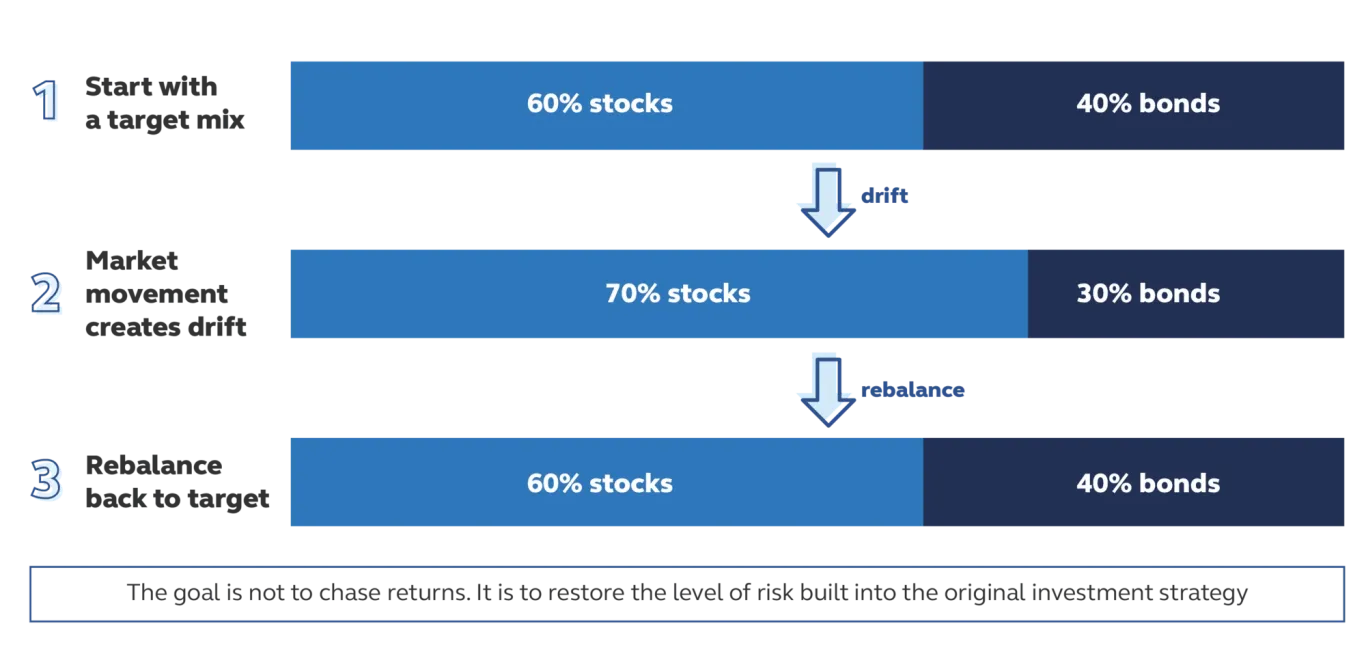
Rebalancing brings your asset allocation or investment mix back to how you originally set it.
Investment values don’t all rise and fall at the same pace. If there’s a type of asset you’re invested in that grows more quickly than another, it can begin to represent a larger percentage of your savings. That can change your account’s overall level of risk.
For example, stocks generally have greater potential for gains and losses than fixed-income investments. So, if stocks grow from 60% to 70% of your account, your savings may experience larger swings than you originally intended.
Rebalancing can bring your investments back toward the strategy you had in mind. It’s a way to be a disciplined investor and can help keep you from making emotional decisions whenever short-term market changes occur.
The purpose of rebalancing isn’t to time the market or maximize returns. Rather, it’s a quick check that can help you stay the course.
There are a few different approaches you can take when it comes to rebalancing: calendar-based, threshold-based, and life-event-based. Let’s take a closer look at each.
There are a few different approaches you can take when it comes to rebalancing: Consider rebalancing once or twice a year to ensure your investment mix is aligned with your goals. This is a common approach among long-term investors because of its ease and predictability. You can think about rebalancing during your mid-year or year-end
Another approach is to rebalance when your investment mix changes by a certain percentage. A common percentage used is 5%. If your main asset allocations deviate 5% or more from your target allocation, it may be time to think about rebalancing to keep your portfolio closer to your intended target.
If you experience a significant life event, that can be a good time to revisit your investment strategy and consider rebalancing. As life events occur, like getting married or divorced, having a child, or experiencing changes in your income, your risk tolerance may change. Look at rebalancing your investment mix at these points to align with changing goals.
Before making any changes, think about your financial goals. Has anything changed since you originally selected your investments? If something like a major life event or a shorter timeline to retirement has shifted your stance on risk, that might affect how you invest today compared with when you first started saving.
Rebalancing isn’t the same as changing your investment strategy. Rebalancing means making changes to restore your original investment mix. If your goals, timeline, or tolerance for risk have changed, you may first need to decide whether your target investment mix still makes sense for your current situation.
Once you’ve confirmed your target investment mix, compare it with where things stand today. Identify how your current investments are divided among stocks, bonds, and other investments, and figure out whether they may have drifted from your original intent. Remember to consider all your accounts related to the same goal, like retirement, as part of the bigger picture.
If you need to rebalance, you have three options for how to make adjustments.
You can send future savings toward an investment class that makes up a smaller percentage of your portfolio that you want to grow. This approach can help move your investments back toward your target allocation over time without requiring you to sell any existing investments.
If you’re too highly invested in one asset class, you can sell a percentage of those investments and buy more in another asset class. Keep in mind that selling investments when prices are down may mean locking in losses that could have recovered over time.
Principal® has tools that can automatically keep your investment mix aligned with your chosen strategy. To set this up, just
For guidance on creating an investment mix that matches your financial goals, consider managed accounts services, if offered in your organization’s plan. These services are overseen by a registered investment advisor and can use your goals, timeline, and risk tolerance to create an investing plan personalized to you. The investments are managed on an ongoing basis and rebalanced quarterly to keep your investment strategy aligned with your goals. To view features in your plan that can help with your investing decisions, log in to your account and click Investments. Then select Change your investments from the dropdown menu.
About Target Date investment options: Target date portfolios are managed toward a particular target date, or the approximate date the investor is expected to start withdrawing money from the portfolio. As each target date portfolio approaches its target date, the investment mix becomes more conservative by increasing exposure to generally more conservative investments and reducing exposure to typically more aggressive investments. Neither the principal nor the underlying assets of target date portfolios are guaranteed at any time, including the target date. Investment risk remains at all times. Asset allocation and diversification do not ensure a profit or protect against a loss. Be sure to see the relevant prospectus or offering document for full discussion of a target date investment option including determination of when the portfolio achieves its most conservative allocation.
Before exchanging existing investments, check whether the transaction could result in taxes or fees. These considerations may differ between workplace retirement accounts and taxable investment accounts. If you’re unsure how a change could affect you, consider consulting a financial or tax professional.
- Rebalancing too frequently. Rebalancing is meant to keep you on target for your long-term goals, not a way to react to every minor market fluctuation.
- Trying to predict market movements. Maintaining a steady, disciplined approach may help maintain your investment mix based on your goals, timeline, and risk tolerance. Rebalancing isn’t about guessing which investments will perform best.
- Letting emotions drive decisions. Market highs and lows can trigger strong emotional reactions. Having a rebalancing plan in place can help you make decisions based on your investment strategy rather than fear or excitement.
- Ignoring changing goals or life circumstances. Your investment strategy should reflect your current situation. Major life events may be a good reason to review your investments and make sure your mix still makes sense for you.
- Focusing only on returns rather than risk. Rebalancing is a risk-management tool. The goal isn’t necessarily to maximize returns, but to help ensure your investments continue to align with the level of risk you’re comfortable with.
Market gains and losses can cause your investments to drift away from the mix you originally selected, which can change your portfolio’s risk level. Rebalancing is a simple way to stay aligned with your plan, rather than reacting to what the markets may do next.
Log in to your Principal account to check on your investment strategy.