A 457(b) nonqualified deferred compensation (NQDC) plan is a special benefit that helps key employees like you save more, manage your taxes, and retire on your schedule. Use these resources to learn about plan features, benefits, and considerations.

- It’s a plan designed to help key employees save for the future.
- It allows you to save additional pre-tax dollars up to the limits of qualified plans.
- You contribute a portion of each paycheck to the plan, which can grow tax-deferred until you take distributions.
Explore these short videos to get up to speed on 457(b) plan basics, how the plan could help you manage your taxes, what to expect when you enroll, and more.
| Feature | 403(b) plan | 457(b) plan |
|---|---|---|
| Contribution limits | Contributions capped at the yearly IRS limit. | Contributions capped at the yearly IRS limit. |
| Changing deferrals | May change deferral amounts at any time during the year. | May change deferral amounts monthly. |
| Tax-deferred status | Pre-tax contributions and investment earnings are tax-deferred until distributed. | Contributions and investment earnings are tax-deferred until distributed. |
| Access to your money while employed | Depending on the plan, a loan may be available, which must be repaid with interest. | Unscheduled withdrawals aren’t permitted. |
| Distribution options | Lump sum or partial payments. If distributed before 59½, a 10% penalty may also apply. May be “rolled over” into an IRA or other qualified plan within 60 days following distribution. | Could be lump sum or installments. Generally, you’ll receive the distribution(s) within 60 days after leaving your employer. Select plans may allow you to defer your payments to a later date up to your required minimum distribution (RMD) age. May be transferred to another non-governmental 457(b) plan, if both plans allow. |
| Investment options | Offers a variety of investment options. | Offers a variety of investment options through reference investments. |
| Risk | Investment risk based on fund selection and market performance. Balances are secured from creditors in the event of company bankruptcy. | Investment risk based on fund selection and market performance. Participants would be unsecured creditors in the event of company bankruptcy |
- Save more. Deferred comp can help you save beyond the limits of qualified plans like a 403(b). And pre-tax deferrals result in tax-deferred growth, allowing compounded earnings to help you save more. With a 457(b) plan, you can save up to the standard deferral limit for the year.
- Manage your taxes. Deferring a portion of your compensation reduces your taxable income. And you’ll have more control over how and when you pay taxes on what you saved.
- Retire on your schedule. With no age-based rules on when you receive deferred comp income, the plan could potentially help you retire early.
- Are you maximizing your qualified plan?
- If not, do that first and use catch-up contributions if you’re age 50 or older.
- Savings in qualified plans like a 403(b) plan are yours and protected from creditors by federal law.
- Keep in mind that deferred comp deferrals reduce the income available to contribute to a qualified plan.
- Note: You can’t roll money over from a qualified to a nonqualified plan.
- Can you afford to defer income additional income—with no loan or withdrawal?
- You have the ability to adjust your deferral amount monthly.
- Do you want to lower your tax rate?
- If so, a 457(b) plan can help.
- Distributions are treated as ordinary income when they’re paid out, and they’re subject to current federal and state income tax.
- Are you concerned about meeting your retirement savings goals?
- If so, the 457(b) plan can supplement your other savings plans.
- If not, deferred comp could still help you meet other financial goals in retirement like funding health care.
- 457(b) plans have a special catch-up provision, allowing you to potentially make additional catch-up contributions during the three years prior to the plan’s normal retirement age. Unlike qualified plans and governmental 457(b) plans, it isn't based on reaching age 50 or a present amount.
- Are you confident in your employer’s success?
- Nonqualified plans have fewer government-imposed restrictions than qualified plans, but they don’t have the same government protections.
- Some plans place deferred compensation in a trust, which is used to hold assets and pay benefits. While your employer retains control of any deferred money until it’s paid out, the trust protects you from a change of control in company ownership. It also helps to protect you from a later change of heart by your employer—after you’ve deferred income but before it’s paid out.
- The only situation where your company’s promise to pay out deferred compensation could be broken is if it became insolvent or went bankrupt. Then, the bankruptcy process would determine how or if you’d get paid.
Check out
Distributions, or payouts, are how you receive money from your 457(b) plan.
- For a 457(b) plan, the distribution will pay out:
- Once you leave your employer, regardless of age.
- It can help replace your income after you’ve stopped working but before you start drawing down other retirement savings.
- You may have the option to push your distribution payment to a later date.
- Once you leave your employer, regardless of age.
- If you leave your employer and are hired at an employer with the same non-governmental 457(b) plan, you may be allowed to transfer your balance into that plan.
- Distributions occur depending on your employer’s plan design. The money is paid out in lump sums or installments.
- Depending on how your employer set up the plan, installments typically are paid out annually.
- Events both in your control (such as leaving for a new job or retiring) and out of it (like death or a disability) can trigger distributions.
- Decisions made when establishing accounts during the enrollment process determine how the accounts distribute.
- You’ll pay federal income taxes on the amount paid out, along with any applicable state taxes, the year you receive your distribution.
- If deferred income is needed unexpectedly, circumstances like death, disability, a change in company control, or unforeseen financial hardship may qualify you to receive this money outside of when it was planned to be distributed. During enrollment, you designate how to receive your money from the plan should one of these situations occur.
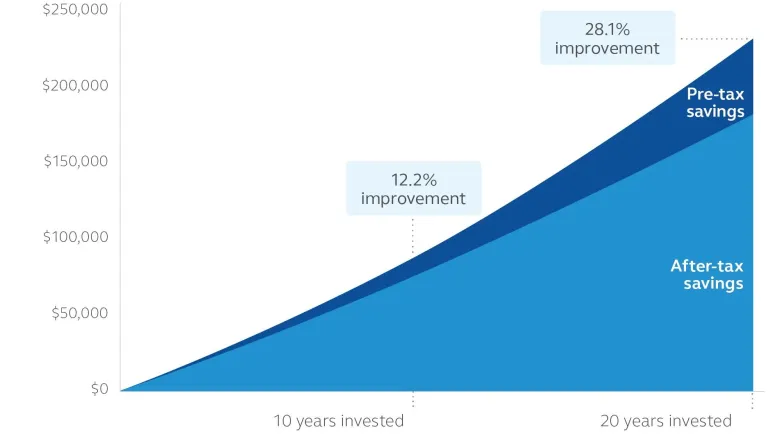
Thanks to compound interest, the tax-deferred advantage increases the longer you let your balance grow. The example below1 shows that over time, assuming the same earnings rate, you’d have a larger account value from a pre-tax investment.
- With a deferred comp plan, you can also defer your highest tax bracket income to help lower your actual tax rate, as in the example below.
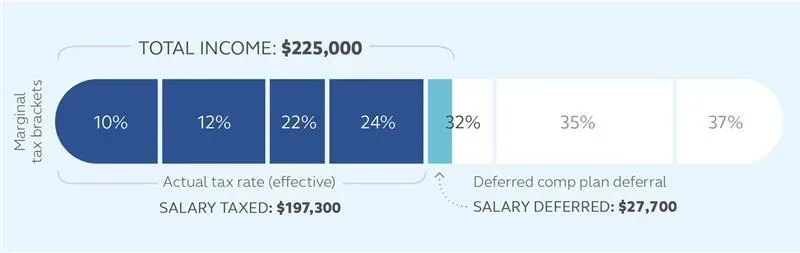
- You pay income taxes when you receive the money you’ve deferred. Depending on when you receive your payout,
you could lower your annual taxable income (video) enough to drop into a lower tax bracket in your retirement years. - Keep in mind that distributions from a nonqualified deferred comp plan are treated as ordinary income, and are subject to current federal and state income tax.
1 The illustration is a hypothetical example showing the principle of compounding. This example assumes an initial investment of $10,000 with ongoing annual contributions of $10,000 growing at an annual 6% rate of return compounded annually over a 20 year period. The example does not include the impact of any fees and expenses that would be associated with an actual investment. It does include a lump sum distribution of the pre-tax amount with a 40% tax rate. This hypothetical illustration is not intended to represent any specific type of investment. Keep in mind there is no assurance the investment will grow at a steady rate of return and consumers need to consider their personal investment horizon and income tax bracket, both current and anticipated when making investment decisions as these may further impact the results of the comparison.
- Rather than investing directly into funds, nonqualified plans use “reference” investments—a plan requirement to help preserve the tax-deferred status of the plan.
- You can direct your deferrals toward a variety of reference investment options that align with your risk profile.
- Reference investments you select may or may not actually be selected by your employer.
- A reference investment mirrors the performance of an actual investment and is used solely for the purpose of calculating earnings.
- Any potential growth or loss is determined by the performance of the reference investment you chose.
Take a quiz (PDF) to assess your comfort level with investment risk.
Learn more about how 457(b) plan distributions work.
Distributions are triggered by events:
- Within your control, like leaving an employer for a new job or due to retirement.
- Out of your control, such as a death, disability, change in the company’s control, or financial hardship.
- Generally, you will receive your distribution(s) within 60 days after leaving your employer. If you would like to defer your distribution to a later date, and your plan allows it, you will need to provide written notice to your employer within 60 days of your last day of employment.
- If you leave to work for another not-for-profit entity that offers a non-governmental NQ 457(b) plan that accepts transfers you could transfer your balance to the new employer’s 457(b) plan.
- Upon enrolling in the plan, you made an election to have your account balance distributed upon death, disability or separation from service. These options are generally a single lump sum or limited duration annual installments. Payments generally begin within 60 days following the distributable event.
- Depending on how your plan is set up, you may be able to defer the payment past the 60 day timeframe, you can discuss this further with your employer.
- If your employer issues payment, contact your human resources representative to get a date. If your check is issued by Principal®, you can expect payment to be made within 7-10 business days following distribution date. If you are not sure who is issuing the payment call Principal.
- You’ll pay federal income taxes on the amount paid out, in addition to any applicable state taxes. Distributions are taxable in the year that the distributions are paid, not when the check is issued.
- Note: Depending on the timing of the distribution, you may be taxed either under the laws of the state you worked in or the state where you receive your distribution, or both.
The distribution will be paid when you leave your employer due to retirement or at separation from your employer.
- Lump sum. You get the entire account balance on a date you’ve selected.
- Installments. You get a portion of the balance at a time you’ve chosen, and what remains in your account has potential to continue growing tax-deferred.
- For example, you could have annual installments from your account paying out around each valuation anniversary for five years.
Some plans allow for changes to the frequency or method of payment. 457(b) plans are required to specify a default payment time and form relative to an event—for example, a lump-sum payment 60 days following the participant’s separation. While 401(k) and 403(b) plans generally require participant action to distribute balances, 457(b) plans are the opposite and require participant action to delay payment.
- 457(b) plans do not allow traditional age-50 catch-up contributions, or super catch-up contributions.
- There’s a special 3-year catch-up provision that allows you to potentially contribute over the annual limit. This only applies if you’ve under contributed (relative to annual limits) in prior years. This is only available if you’re within three years of your employer’s “normal retirement age.” Talk with your employer to determine their normal retirement age.
- Learn more about the
catch-up provision (PDF) .
- You typically have the option to change your deferral monthly.
- All deferral elections take effect as of the month following the election, and not the next immediate pay cycle.
If your check is issued by Principal, you can expect payment to be made within 7-10 business days following distribution date. If you are choosing direct deposit, make sure your updated account information is entered.
- Deferred comp plans use reference investments, which don’t invest directly into funds. Reference investments track alongside real investments (like stocks, bonds, or mutual funds), and they’re used solely for the purpose of calculating earnings.
- Any potential growth or loss is determined by the performance of the reference investments you chose.
- Reference investments help determine:
- How your deferred money grows over time.
- What your eventual payout will be.
- How market performance affects your deferred compensation.
- For example, if you choose to reference a mutual fund that grows by 10%, your deferred money would grow by 10% too, even though no actual investment was made.
- Reference investments help preserve the tax-deferred status of the deferred compensation plan.
Your employer chooses the reference investments available for the plan. You can change your investments at any time by
- No, deferred comp can’t be rolled over.
- If you leave your employer and are hired at an employer with the same non-governmental 457(b) plan, you may be allowed to transfer your balance into that plan.