
Digital finance is helping more people access faster payments, online accounts, credit, and other financial services. But as financial technology advances, the regulatory systems designed to protect consumers may be struggling to keep pace.
Since the Global Financial Inclusion Index launched in 2022, real-time transaction volumes have increased in 28 of the 42 markets studied. Online connectivity has improved in 35 markets over the same period. Together, these developments have made digital financial infrastructure an increasingly important driver of financial inclusion.
Transactions, connectivity, and regulation
(Weighted averages by year)
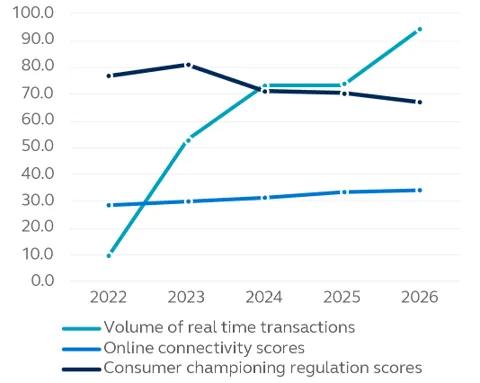
Consumer protections haven't followed the same trajectory. In 2026, scores measuring the extent to which governments champion consumer-protection regulation declined in 29 of the 42 markets assessed. Among the markets that declined, scores fell by an average of 3.1 points.
The result is a growing tension: The technology connecting people to financial products and services is advancing faster than some of the regulatory frameworks governing those products.
The contrast is particularly visible in Latin America, which has experienced some of the fastest growth in financial digitization since the Index began.
Since 2022, the region’s average score for real-time transaction volumes has increased by almost 150 points, compared with an increase of approximately 85 points globally. Argentina and Brazil now receive the maximum score of 250.9 for this indicator, while Chile scores 113.7.
Connectivity has improved as well. Latin America’s regional connectivity score is now above the global average, at 36.4 compared with 34.0, with internet access having improved faster in Latin America compared to the full sample (+5.2 points) since 2022.
Consumer-protection regulation tells a different story. Latin America has the lowest regional average for government support of consumer-protection regulation, scoring 33.1 compared with the global average of 67.2. The gap illustrates how rapidly digital financial activity can expand without equivalent progress in the safeguards surrounding it.
Scores for digitization-related indicators are rising far faster than those for financial regulation designed to protect consumers,” said Kamal Bhatia, president and CEO of Principal Asset Management. “With AI accelerating fintech growth and adoption, the gap looks set to widen, creating a clear risk for policymakers to address.
Artificial intelligence adds another dimension. AI is increasingly part of the infrastructure through which financial services are delivered, including automated credit and pricing decisions. Whether it expands financial participation fairly depends partly on the strength of data protections, accountability measures, governance frameworks, and consumer safeguards.
Several rapidly digitizing regions have ground to make up. Latin America averages 45.4 for government-led AI governance and policy frameworks, while Southeast Asia averages 38.8. Both remain below the global average of 63.3. Borrowing is one area where consumer protection risk could become especially visible.
“With far greater access, people historically excluded from traditional credit channels could turn to unregulated or automated products with unclear pricing, weak affordability checks, and opaque use of personal data, increasing the risk of unsuitable borrowing and over-indebtedness,” said Bhatia. “As access to investment and debt broadens, regulatory safety nets must widen and strengthen accordingly.”
The Index also identifies signs of regulatory progress. Thailand, Malaysia, and Vietnam were among the strongest risers in consumer-protection regulation, showing that regulatory development doesn’t have to remain behind digital growth.
The next phase of financial inclusion will depend on more than making financial services faster and easier to access. Lasting progress will require consumer protections and AI governance to evolve alongside technology, helping ensure greater access is supported by transparency, fairness, and trust.