Real-time payments can support financial inclusion when they replace cash. New analysis shows why rising transaction volumes alone don’t tell the entire story.

Real-time payments are making it possible for consumers and merchants to move money in seconds. This speed and convenience can reduce friction and make the formal financial system more accessible, particularly in underserved markets.
But an increase in instant payments doesn't necessarily mean financial inclusion is deepening. The more revealing question is what happens to cash as digital transactions grow.
If real-time payments rise while cash use remains steady or increases, digital activity may be expanding alongside established behavior. If cash use declines as instant payments increase, there’s stronger evidence that digital infrastructure is changing how people transact.
To explore that distinction, the 2026 Global Financial Inclusion Index compared cumulative growth in real-time transactions per capita with changes in currency in circulation as a share of GDP. Cash-displacement data were available for 34 of the 42 markets assessed, allowing markets to be grouped into four broad categories.
Real-time transaction growth vs. change in cash intensity, by market
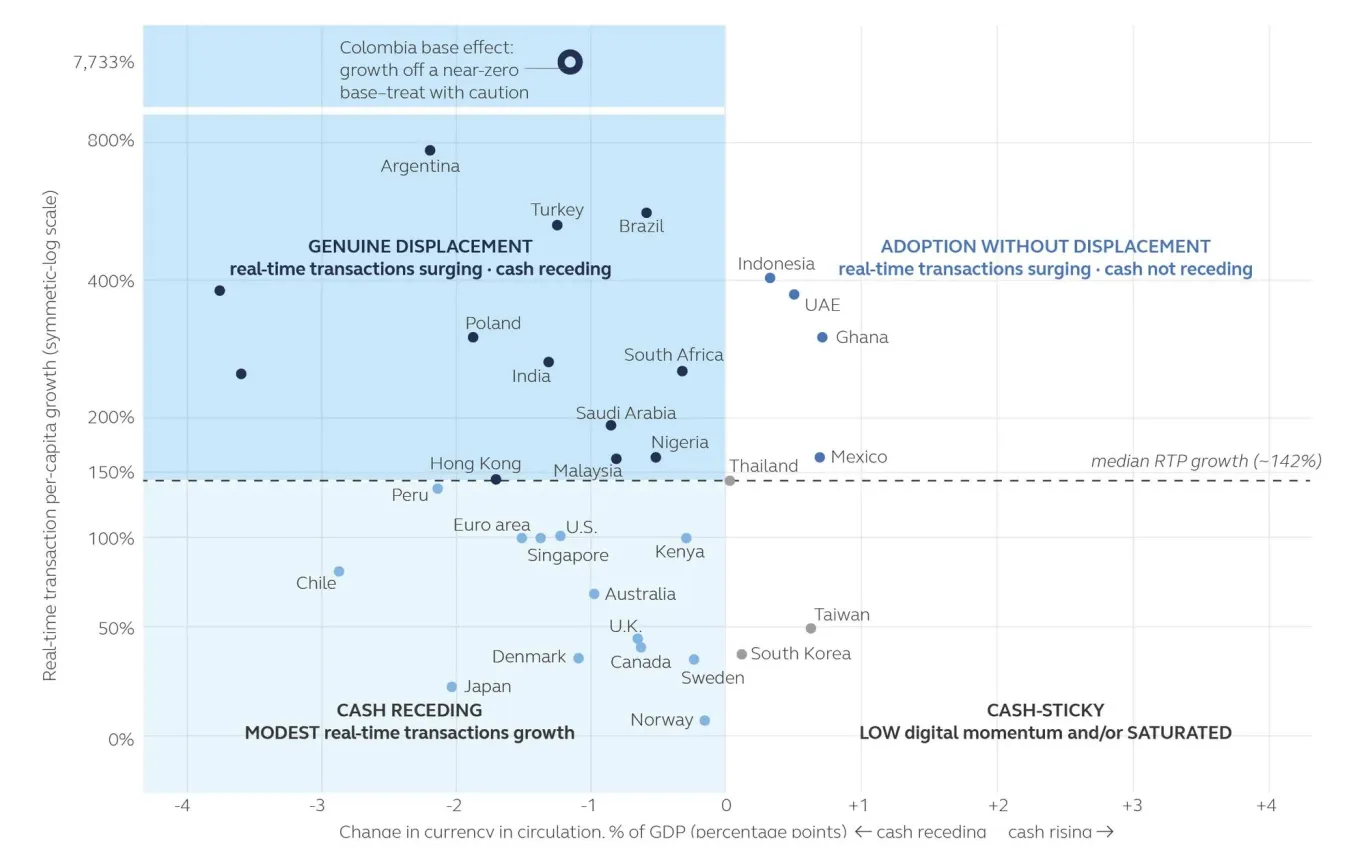
The largest category consists of 13 Genuine Displacers, where real-time payments are growing and cash use is declining. Argentina, Vietnam, Turkey, Switzerland, and India are among the markets in this group. The pattern suggests that instant-payment infrastructure is replacing some cash activity rather than merely adding another way to transact.
A different pattern can be seen among Parallel Infrastructure markets. In Indonesia, the United Arab Emirates, Ghana, and Mexico, real-time transaction volumes and cash use are both growing. Digital-payment activity is expanding, but it hasn't yet displaced cash. Looking at transaction growth alone could therefore overstate the extent to which payment innovation is changing broader participation in the financial system.
The Steady Digitizers combine declining cash use with more moderate growth in real-time payments. This category includes the U.S., U.K., Canada, Australia, the Nordic markets, Singapore, Japan, and the Eurozone.
Many of these markets introduced digital financial infrastructure earlier, allowing cards and other established payment systems to displace cash before real-time payments became widespread. More modest growth in instant transactions shouldn't automatically be interpreted as limited payment innovation.
Other markets in this category have followed different paths. Kenya’s results may reflect its established mobile-money infrastructure, while real-time payment adoption in Chile and Peru is developing from a lower base.
The final category includes Digital Laggards, where cash use remains persistent while growth in real-time transactions is weak or slowing. However, the markets within this group have distinct circumstances. South Korea appears to have reached a saturation point because its real-time transaction penetration is already high. Taiwan’s comparatively low digital-payment growth points to a greater inclination to use cash.
These patterns demonstrate why technology should be considered an enabler of financial inclusion rather than its sole measure.
“In the Parallel Infrastructure and Digital Laggards categories, technology can make the financial ecosystem faster and more frictionless, but often only for those already participating in it,” said Kathy Kay, executive vice president and chief information officer at Principal Financial Group. “It does not necessarily create a pathway into the system for those who remain excluded.”
Cash can remain embedded across informal communities, rural areas, small merchants, and segments that continue to prefer it. In those circumstances, rising digital-payment volumes can coexist with persistent barriers to participation. The report presents this as a possible interpretation of the pattern, not a measured causal relationship.
The success of real-time payment infrastructure should therefore be judged by more than transaction volume. The stronger indication of progress is whether digital payments change behavior, reduce reliance on cash, and help more people participate meaningfully in the formal financial system.