
A single year of data captures a point in time. Five years reveal patterns and trends.
Since the launch of the Global Financial Inclusion Index in 2022, the world has navigated post-pandemic return to normalcy, inflation, economic uncertainty, geopolitical disruption, rapid fintech adoption, and the emergence of AI-driven financial services. Through each shift, the Index has tracked how governments, employers, and financial systems are helping people access the tools, knowledge, and support needed to build financial security.
Now, with five years of research, a clearer story is emerging: Some long-held assumptions about financial inclusion are being challenged. Developing markets are gaining ground. Traditional leaders are facing new pressures. And the institutions that have the greatest influence on financial inclusion are evolving in different ways.
With five years of data, we have a clearer picture of the markets where financial inclusion is improving, where progress is slowing, and how the roles of governments, financial institutions, and employers continue to evolve
So what have we learned after five years of tracking financial inclusion across 42 markets?
Q: Has global financial inclusion improved over the past five years?
A: Yes. The research shows that financial inclusion has strengthened overall, although progress varies by market and by the type of support available.
Leadership at the top and bottom of the Index has been relatively stable. Singapore and Hong Kong have consistently ranked among the strongest performers, while Colombia, Nigeria, Peru, and Ghana have remained near the bottom. At the same time, significant movement has occurred elsewhere. South Korea has climbed 23 places since 2022, and Thailand, Argentina, Vietnam, and Brazil have also made material gains.
Takeaway
A market’s current position tells only part of the story. Examining movement over time can reveal where the foundations of financial inclusion are strengthening.
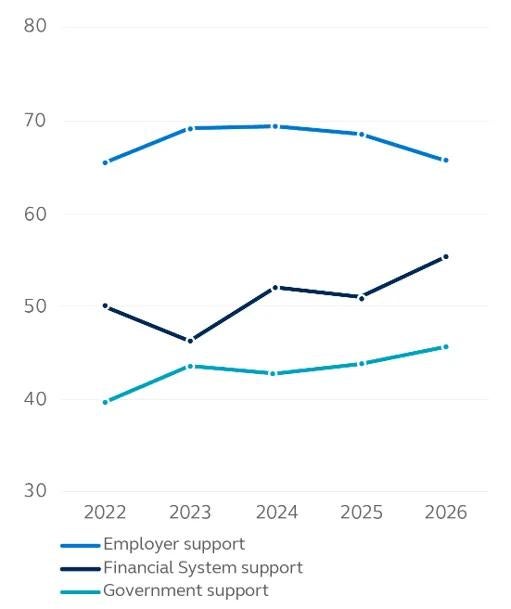
Two pillars at series highs, one back where it started
Q: Does a market’s level of economic development determine its progress?
A: Not necessarily. Several developing markets are advancing, particularly through stronger financial systems, while a number of advanced economies have lost relative ground.
Germany has recorded the largest overall decline since 2022. Finland, Norway, New Zealand, Canada, and Australia have also moved backward across parts of the Index. These shifts point to a gradual reshaping of the traditional divide between developed markets near the top and developing markets near the bottom.
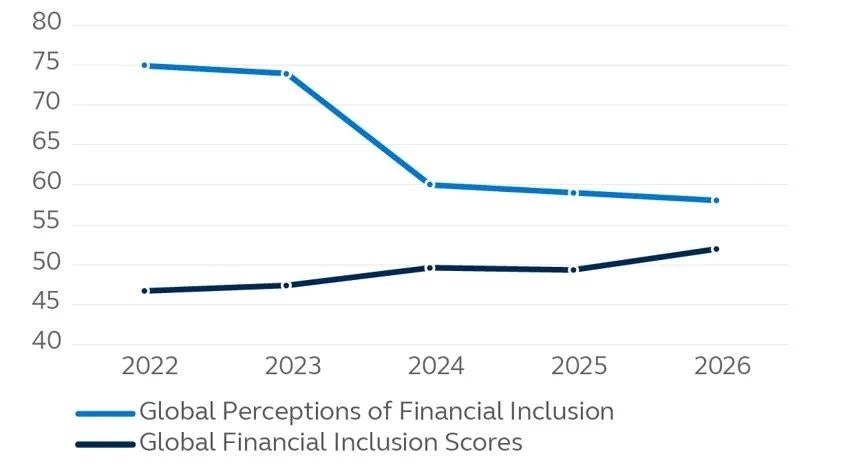
And while financial inclusion scores have improved over the past five years, populations feel less included than ever. The percentage of people who feel financially included fell from 58.6% in 2025 to 57.6% in 2026, down significantly from 74.8% in 2022. Overall perceptions of financial inclusion fell year over year in 25 of 42 markets, compared with 17 markets in 2025.
Takeaway
Modern, accessible financial systems can broaden participation, but progress must ultimately produce greater financial confidence, resilience, and security in people’s daily lives.
Q: What has driven the largest changes in financial inclusion?
A: Financial system support has been one of the most important sources of movement.
Improvements in this pillar have helped markets including Brazil, Vietnam, India, Argentina, Thailand, and South Korea gain ground. By contrast, financial system support has slipped in several developed economies. Government support has been more stable, with Singapore, Switzerland, and Norway consistently ranking among the leading markets.
Q: What role do employers play in financial inclusion?
A: The workplace remains an important pathway to financial inclusion, but employer support follows a different pattern from broader economic development.
Asian and Middle Eastern markets have consistently occupied the top tier for employer support, while several Western economies, including Canada, the U.K., Germany, Australia, and New Zealand, have remained near the bottom. Where government or financial system support is less comprehensive, employers often assume a greater role in providing benefits, financial guidance, and other resources.
“Falling perceptions of employer support reflect a post-pandemic cycle,” says Seema Shah, chief global strategist in Principal Asset Management. “Employer support improved from 2022 to 2024 alongside the post-COVID recovery, but the significant tightening of monetary policy from mid-2022 onward eventually cooled demand and loosened labor markets. With the competition for workers easing while employers continued to face elevated cost bases, the incentive and capacity to maintain some of these provisions has diminished.”
Takeaway
Employer-led financial inclusion is shaped not simply by a market’s wealth, but by the role businesses are expected to play in its financial ecosystem
Q: What’s the most important lesson for the next five years?
A: Long-term progress requires shared responsibility.
“Five years of this research has reinforced what we instinctively know to be true: Progress requires shared responsibility,” says Strable. "Governments, financial institutions, and employers each have an important role. By working together to strengthen financial inclusion and help people make the most of the resources available to them, we can create greater financial confidence and opportunity for more people around the world.”