See how improving pension data can help plan sponsors reduce inefficiencies, better understand plan costs, and prepare for future risk management decisions.


Even small inconsistencies in pension data can be easy to overlook. A single incorrect record in a defined benefit (DB) census file may not seem significant, especially when plans rely on estimates during actuarial valuations and correct records later when benefits begin.
But as plan sponsors have seen improved DB plan funded status, rising interest in risk transfer, and increased scrutiny around plan costs, the margin for data error is shrinking. What once felt manageable at the individual level can scale into substantial financial, operational, and strategic consequences across the plan since liabilities are ultimately determined at the participant level.
For plan sponsors, improving data quality can help support more informed decisions across three key areas: cost, efficiency, and risk.
Signs your pension data may need review
Plan sponsors may want to consider a data review if:
- Participant records haven’t been audited in several years
- There are large populations of terminated vested participants
- The plan has undergone mergers or acquisitions
- Risk transfer or plan termination is under consideration
Data inaccuracies don’t just create noise in pension reporting; they can systematically increase reported liabilities and distort the overall cost picture. Data review projects often identify cases where plan obligations may be overstated. One common example is when deceased participants remain in plan records because their status hasn’t been updated.
Despite advances in technology, deaths of participants and beneficiaries can still go unreported, particularly among vested participants who were terminated and are no longer actively engaged with the plan. Unless verified, these individuals may continue to be included in liability calculations, increasing the plan’s reported obligations.
The financial impact of correcting these records can be significant. Consider a hypothetical plan with $100 million in total liabilities.
- A 1% increase in the plan’s funding ratio
- An annual minimum contribution reduction of approximately $100,000
- A reduction in PBGC premiums of up to $54,000 annually
- A $1 million improvement to the plan sponsor’s balance sheet A $1 million reduction in accumulated other comprehensive income (AOCI)
- A reduction in annual pension accounting expense of approximately $50,000 to $100,000
These results will vary by plan, but they show how even modest improvements in data accuracy may lead to measurable financial changes.
Many plans still operate under a model in which data validation, cleanup, and benefit calculations occur when a participant begins receiving benefits. This can require significant manual work from human resource teams and external partners, creating a detailed review process for each individual.
Reviewing and correcting data before participants begin benefits can help reduce the time and cost of administering future pension events. By addressing inconsistencies earlier, plan sponsors may be able to streamline operations, reduce administrative bottlenecks, and shift internal resources toward a higher-value plan strategy rather than manual exception handling.
There are typically different levels of data improvement to consider:
- Demographic data verification, such as birth dates, employment history, and contact information. These updates are often straightforward and may require less time and cost.
- Benefit certification, which confirms the accuracy of each participant’s accrued benefit. This step may require more internal and external support, particularly for plans that have grown through mergers and acquisitions, where historical records may be incomplete. In some cases, full certification may not be possible if supporting records are unavailable.
When both demographic data and benefit amounts are reviewed and validated, plan sponsors may be better positioned to simplify administration and improve consistency over time.
The importance of pension data accuracy often increases as plan sponsors focus more on managing and transferring risk. Pension funding levels have improved in recent years, leading many plan sponsors to take a fresh look at their long-term strategy. As they do, having a clear and accurate view of plan liabilities becomes more important.
Liability-driven investment (LDI) strategies are designed to align plan assets with expected liability cash flows, often using high-quality bonds with similar timing. These strategies may also adjust asset allocation based on the plan’s funded status.
Inaccurate data can affect these projections, which may lead to mismatches, misstatements of funded status, or added volatility. While results will vary, this highlights the role accurate data can play in supporting investment decisions. Because LDI strategies depend on the precise timing of benefit payments, even small demographic or benefit inaccuracies can distort cash flow projections in ways that may not be immediately visible.
Data quality becomes even more important when plan sponsors consider transferring risk through lump sum offers or annuity purchases. For example, outdated mailing addresses for terminated vested participants may lead to returned communications and lower response rates, which can increase plan termination costs if more liabilities remain in the plan than expected.
Insurers also rely on participant data when pricing pension risk transfer transactions. Data gaps or uncertainty can increase administrative complexity, which may be reflected in pricing.
Even small pricing differences can have a noticeable impact. For example, a 0.5% improvement in underwriting on a $100 million annuity transaction represents a $500,000 difference. While outcomes will vary, this highlights how more complete and accurate data may support more efficient transactions.
Pension Data Quality Levels
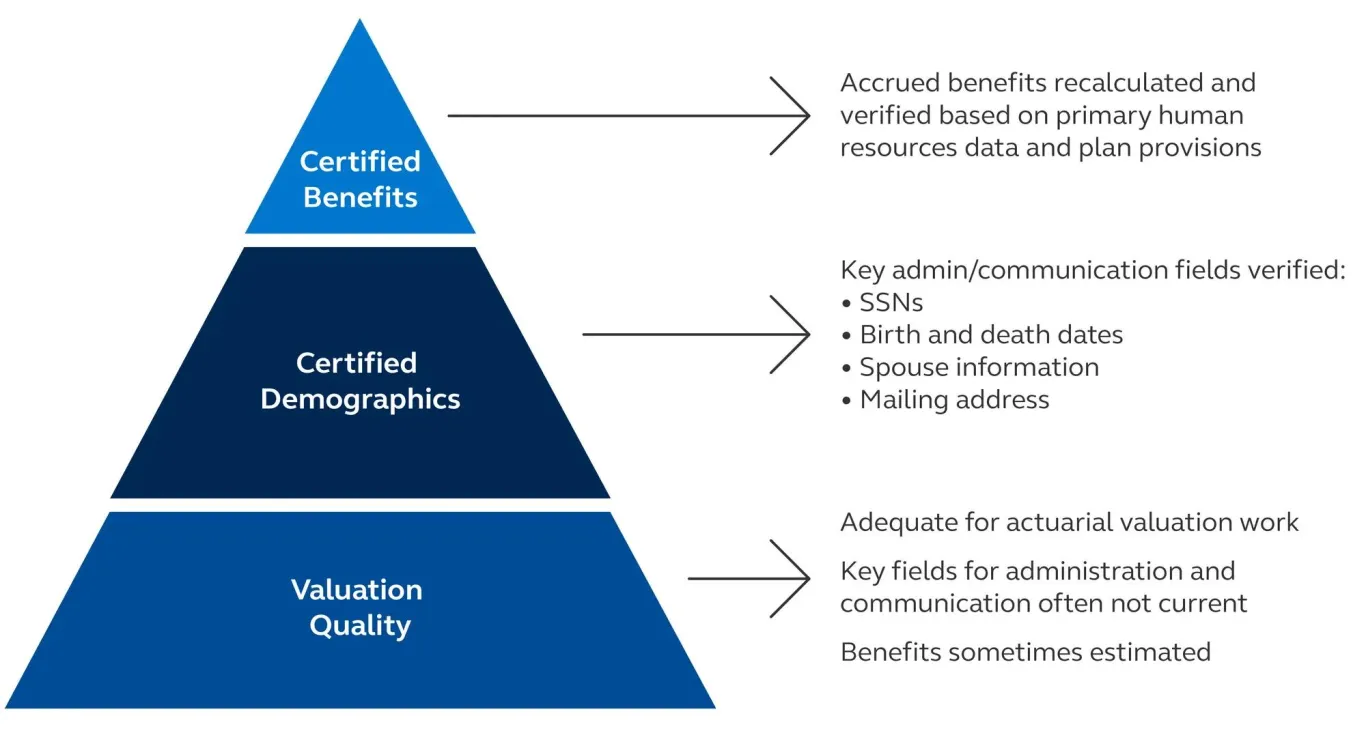
For illustrative purposes only.
Improving pension data may not always rise to the top of the priority list until a triggering event makes it urgent.
For some plan sponsors, that trigger may already be happening with a stronger funded status, increased interest in pension risk transfer, or a desire to reduce long-term plan volatility. In these moments, data quality shifts from low priority to a critical enabler of decision-making.
Addressing data gaps earlier may help plan sponsors act with greater confidence when these opportunities arise, rather than reacting under compressed timelines.
What’s next?
If you’re considering de-risking, improving funded status outcomes, or streamlining administration, now may be the right time to evaluate your pension data..
Connect with your Principal® representative to evaluate where data gaps may exist and how addressing them can support your plan strategy. Together, we can identify opportunities to enhance cost efficiency, streamline administration, and position your plan for future risk management decisions.