RILAs offer defined outcome investment options that allow clients to personalize their investment strategies.
Segment options
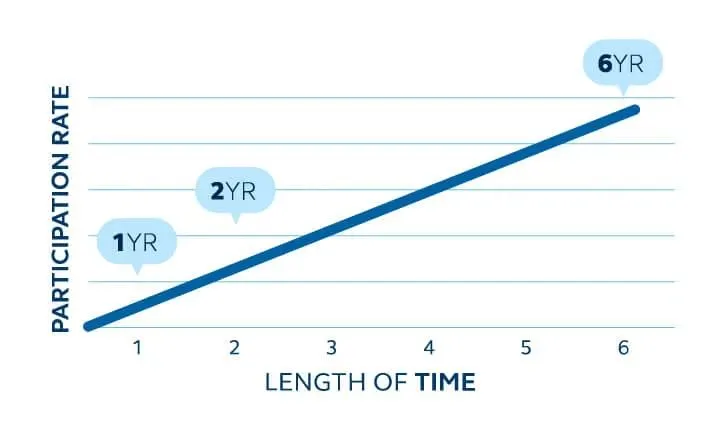
Segments of one, two, and six years.
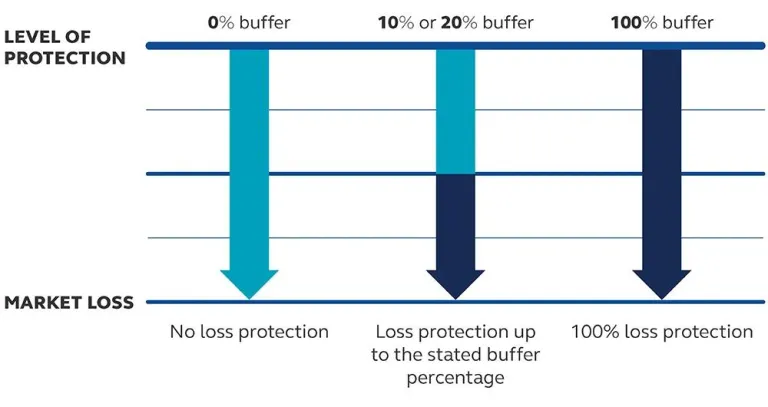
Level of protection
Buffers, peak buffer, or a fixed account.
Investment growth strategies
Multiple indices available.
Clients can choose one or more investment options called segments. Each segment is linked to a specific index for a defined length of time. Some protection against investment loss is available with either a buffer. A fixed segment option is also available.
Clients can mix segment options to help diversify their investment and to help manage their comfort with financial risk.
For illustrative purposes only.
Investing in longer segments provide higher participation rates, and the opportunity for higher account gains. Shorter segments provide more investment flexibility by allowing clients to move assets around more frequently.
The segment lock-in feature comes automatically at no extra charge. It allows clients to lock in the performance of their segment, removing them from market movement until the next segment anniversary. A different performance lock-in can be chosen for each segment clients invest in.
The performance threshold can be set in advance, activating the lock-in feature if predetermined performance levels are met. Or performance can be locked in at any time. And this can all be done online at principal.com.
Each segment option offers a protection strategy to help protect clients from some investment loss.
For illustrative purposes only.
For illustrative purposes only.
You can invest in a fixed segment, as well as an index-linked segment with a 100% buffer. Both of these provide you with an opportunity to allocate assets without risk of losing any account value due to market performance.
Amounts allocated to a fixed segment option earn interest at the applicable annual interest rate for the segment term. The annual interest rate declared at the beginning of the segment term is guaranteed until the segment end date.
If you allocate your accumulated value to the fixed segment option, the value of that segment at any time will be equal to the accumulated value allocated on the fixed segment start date, plus interest during the segment term and minus any amount deducted during the segment term.
Growth within a RILA depends on the performance of a segment’s linked index. Point-to-point index crediting is used to calculate change from the segment start date to its end date.
Choose from four different indices:
S&P 500® Russell 2000® NASDAQ-100® S&P MIDCAP 400®
Rates are subject to change at any time. For current segment information, please visit
If the accumulated value is allocated when a segment reaches its end date, funds may be transferred to another segment. If a new segment is not elected, the segment will renew into the existing segment if it’s available. If that segment is no longer available, we will select a new segment, based on the terms outlined in the contract.
If the accumulated value is allocated to the fixed segment option, the value of that segment at any time will be equal to the accumulated value allocated on the fixed segment start date, plus interest during the segment term and minus any amount deducted during the segment term.
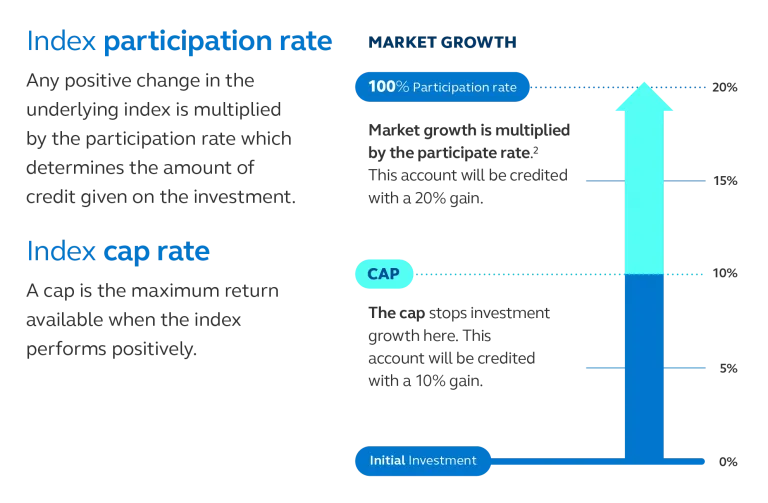
Caps and participation rates and how they affect returns
Participation rates can be more or less than 100%.
For illustrative purposes only.
You may purchase an optional rate enhancement rider that provides higher participation rates and caps, which will result in greater gains in positive performing markets. The rate enhancement rider is not available with Principal® Strategic Income.
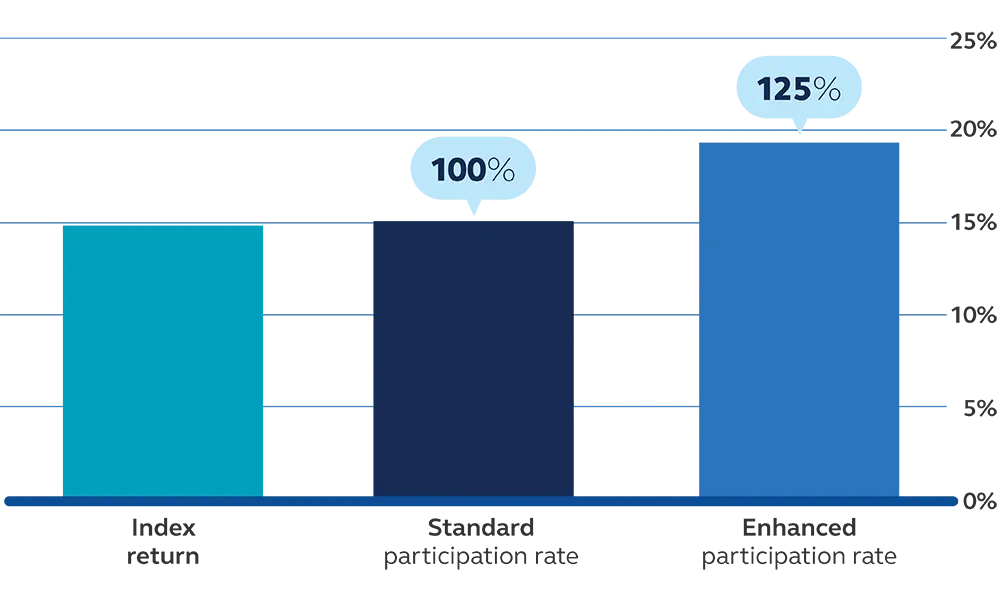
These figures are hypothetical and for illustrative purposes only. They do not guarantee any future returns nor represent the performance of any particular investment.
The flexibility of a RILA from Principal® means you can personalize an investment strategy that meets your needs.
Lessons from the past – See average historical returns of available indices, and how they could have affected hypothetical segment investments.
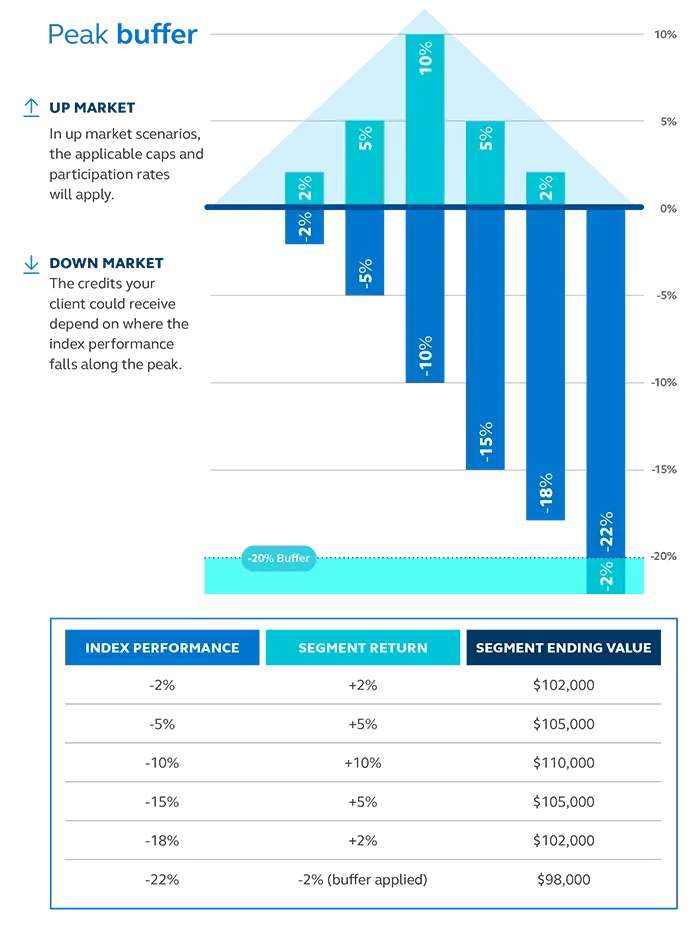
The peak buffer effect – Learn more about how dual direction crediting can provide growth potential, even in down markets.