Plan sponsors need to decide if it is time to protect their gains.


Key takeaways
Actuaries and financial professionals keep watchful eyes over their clients’ pension plans, constantly scanning the horizon for danger. Like the shepherd boy making claims of a wolf threatening his flock, for five straight years now they’ve cried, “Risk! Risk!,” only to see that risk not materialize.
However, it is not as if the warning has no merit. “Flight to quality” events featuring large equity losses and dropping interest rates caused immense damage to the U.S. corporate pension system twice so far this century. Simultaneously plunging assets and spiking liabilities shredded funding ratios, triggered repeated legislative funding relief, and initiated the current ice age of frozen pension accruals.
Perhaps remembering those past dangers, many sponsors have heeded the warnings, lowering their risk by reducing stock market exposure and increasing allocations to long duration bonds to throttle net interest rate volatility. But many others have not and over the past five years they’ve done just fine.
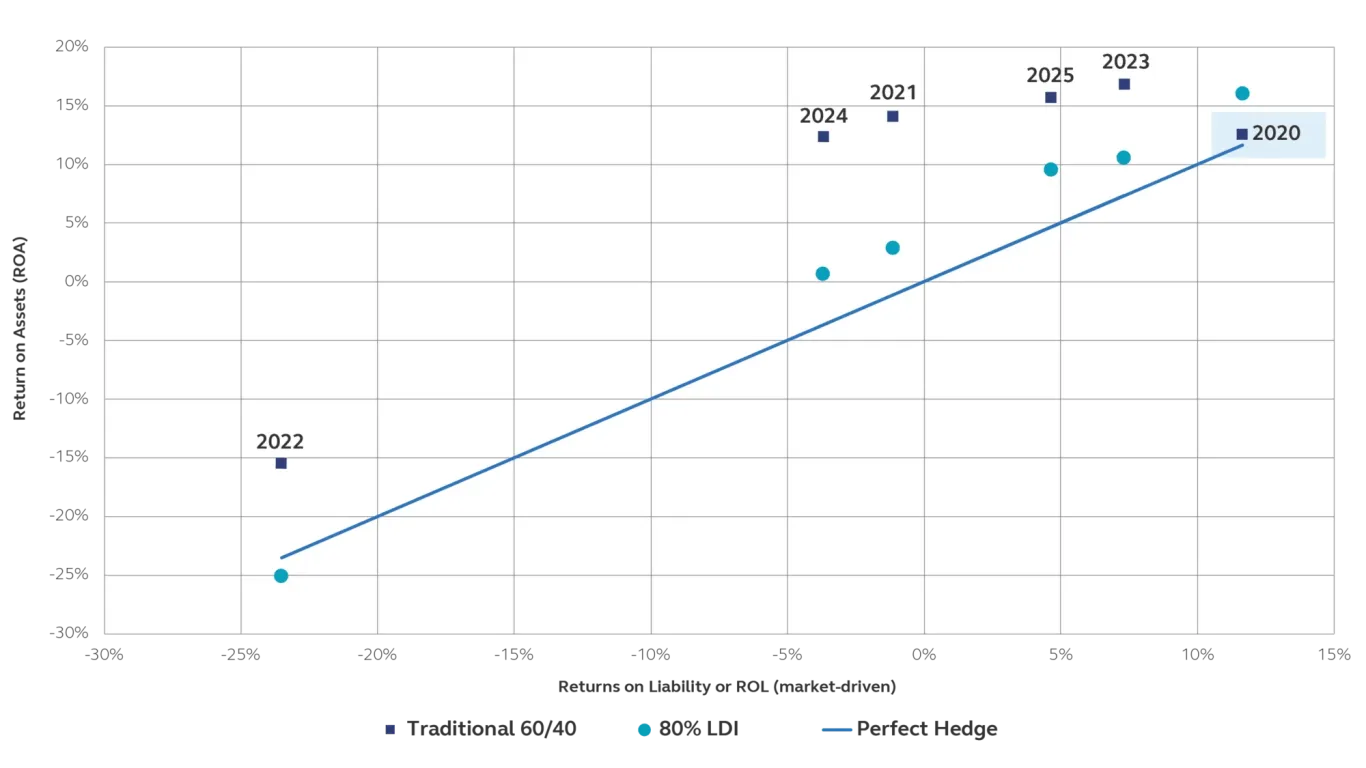
The following chart compares returns for two asset allocations for a hypothetical pension plan. The dark blue squares represent the performance of a pension portfolio that is return-seeking with a traditional allocation of 60% equities and 40% core bonds. The light blue circles represent the performance of a pension portfolio that is liability driven investment (LDI) heavy with an allocation of 20% equities and 80% long duration bonds. The liability duration of this hypothetical plan is 12 years.
Net returns are equal to the vertical distance between the plot point and the blue diagonal “perfect hedge” line --where asset and liability returns are equal. Plots above the line are positive net returns and below are negative.
Portfolio vs. Liability Returns: 2020-2025
Source: Return statistics sourced from the Principal Pension Market Monitor. Examples simplified for illustration purposes.
In each of the last five years, the traditional return seeking portfolio outperformed the LDI portfolio by an average of 9% and the perfect liability hedge by 12%. Even in 2022, when practically all asset classes performed poorly, equities helped to generate a significant positive net return against liabilities. One must go all the way back to 2020 (shaded box on chart) to find a year where the pension shepherds’ warnings paid off and LDI outperformed traditional return-seeking strategies.
Since the wolf hasn’t harassed the flock for five years, it can be easy to forget it exists. With return-seeking portfolios on a half-decade hot streak, some pension plan sponsors are straying further from cover, embracing riskier and less liquid investments to further boost returns. This may not be appropriate for all plans. Times are good, and pension funding ratios remain high – which may be the exact reason to now reexamine investment risk.
Improved funding positions mean lower gross returns are needed to cover benefit accruals (if any) and interest on liabilities. Excise taxes can limit the utility of surplus assets. Equity prices are high and the economic outlook is unclear. The future of long-term bond yields, the determiner of pension liabilities, is uncertain. Perhaps it’s finally time to bring some of the flock just a little closer to safety.
A recent reminder:
In April 2025, market turmoil could have caused a plan’s pension funding to drop 8% in a three-day period. Learn more on navigating market volatility.
In Aesop’s fable, the townsfolk tire of the boy’s repeatedly unrealized warnings of trouble. When the wolf does arrive, their apathy leads to bad results. For pension plan sponsors, when markets move sharply the gap between assets and liabilities can widen quickly—especially for plans not aligned in terms of asset duration and related liability exposure.
It is the nature of pension risk managers to continue sounding the alarm of potential financial danger to all who will listen. The question is whether plan fiduciaries ignore it or listen and reassess their risk exposure in the current environment. Some will let the sheep run, and others will huddle them close.
Whatever 2026 brings, they can’t say they haven’t been warned.
Managing pension risk is our specialty: Work with a leader in pension services.
No matter where you are in your pension journey—from accumulation to hibernation or transfer—we offer tailored solutions for each stage. Explore our defined benefit pension plan solutions.